Using Future Histories to Create Consequential Play
Framing the problem
From time to time I have heard the opinion in the DM-sphere, in the context of player agency, that one task of the DM is to ensure that the actions of PCs should change the world.
In one sense, this should be trivially true: if the Fighter hits a chair with a great sword, the chair breaks – the change in the world is easily computable. In another example, that Fighter now slays the Evil King – what in the world changes? Obviously, the king monologues and then dies dramatically, his ill-gotten crown slipping off his head and clattering onto the stone floor of Skull Keep’s throne room. But is that all that changes?
When I have tried to understand how other DMs handle such larger changes, I have often had the impression that they treat the world as if it exists only at time t and time t+k, where k is very small, almost instantaneous. The DM updates the world at that moment, and the “change” consists chiefly in what happens next.
But this means that the PC has not changed anything beyond the moment. To me, the world extends across very large values of k (into both the past and the future); at time t the world contains structures (e.g. goals, plans, alliances, doctrines, threat perceptions) that point across large values of k.
By “world” I mean the collective of all agents within the world (the system).
By “exists” I mean that, at time t, each agent has already determined some future-oriented stance towards the world: anticipated states, intended outcomes, feared developments, and assumed trajectories. Life is anticipatory, and agents are anticipatory systems. They live not only in the present state of the world, but in an assumed future that they continuously revise as reality unfolds.
The “world” thus contains anticipatory systems, and is better understood not as a discrete thing apprehended at an instant, but as a process continuously carried by anticipatory agents across time.
In summary, it is not sufficient for a PC’s action to change the world merely by changing the next event. PCs change the world in the stronger sense when they alter those future-oriented structures: disrupting plans, expectations, commitments, and trajectories.
My response to this challenge is presented in “Using Future Histories to Create Consequential Play“, which follows.
Using Future Histories to Create Consequential Play
In a TTRPG campaign, players (through their PCs) can only change the world’s future if the world already contains some explicit projected future to change.
Many campaigns that claim the PCs have “changed the world” have merely altered the next step, moving the state of the world from World(t) to World(t+1) and nothing more.
However, agents in the world do not operate on t → t+1. They operate on projected futures. They maintain goals that implicitly define trajectories toward World(t+k) for large k. These trajectories include plans, expectations, and commitments.
For players to meaningfully change the world’s future, the world must therefore contain articulated projected trajectories — plans, intentions, or expected developments — that can be disrupted. These projected trajectories constitute what I call a future history (originally I called it a “hero story” but that might be confused for the “hero’s journey”).
When player actions invalidate or redirect a future history, the structure of the future world changes, not merely the next event. Without such projected futures, play can still change what happens next, but it cannot meaningfully alter the longer-term evolution of the world.
Why the Future is Ignored
Why, then, do many DMs not explicitly model this deeper form of change — the alteration of future trajectories? Table 1 below proposes a structured explanation. It presents a conceptual (rather than empirical) constraint analysis explaining why the future history concept is rarely implemented in practice.
It distinguishes second-order factors (broad explanatory domains) from first-order factors (the specific mechanisms that generate them). The aim is to identify why explicit trajectory modelling is rare even among experienced DMs who value consequential play.
Some of these constraints are DM-facing, such as modelling burden and preparation economics; others are player-facing, such as the limited perceptibility of long-range structural change. Still others arise from training traditions, narrative norms, or the time horizon of campaigns. Taken together, these factors help explain why trajectory-level world modelling remains uncommon in practice, even when its value is widely acknowledged.
TABLE 1. Constraints on Explicit Future-Trajectory Modelling in TTRPG Campaigns
Second-Order Factor Name
Second-Order Factor Meaning
First-Order Factor(s) Name and Meaning
I — Operational complexity
A DM-facing factor, distinct from (IV). Explicit trajectory modelling requires maintaining many agents, plans, and dependencies. As agent count rises, the mental and preparation burden increases sharply, discouraging most referees from sustaining such models.
(A) Cognitive load: Mental effort required to track agents, goals, and interactions. (B) Tooling absence: Lack of practical tools or structures for managing multi-agent dynamics. (C) Combinatorial explosion: Rapid growth of possible interactions as the number of agents increases. (D) Preparation ROI: Perceived imbalance between preparation effort and payoff at the table.
II — Cultural training
A TTRPG-specific factor, distinct from (III). Most referees learn their craft from published adventure modules. These typically encode event chains or site exploration rather than long-range strategic agents, shaping expectations of how campaigns “should” operate.
(E) Module inheritance: DM practices learned from published adventures structured around locations or scenes rather than agent plans.
III — Narrative norms
A general dramaturgical/narratological factor, distinct from (II). Across storytelling practices, facilitators often feel responsible for preserving story continuity. As a result, disruptive trajectory changes may be softened or redirected.
(F) Narrative safety: Reluctance to allow player actions to collapse major prepared trajectories. (G) Dramaturgical tradition: Cultural expectation that the facilitator maintains narrative coherence.
IV — Perceptual payoff
A player-facing factor, distinct from (I). Players usually experience the game locally (scene by scene). Immediate consequences already feel meaningful, so deeper structural modelling often provides little visible additional reward. Table cadence also loads here: if diegetic time advances slowly, long-range consequences become harder for players to perceive.
(H) Player perception thresholds: Limits on how much structural change players can perceive from session-to-session play.
V — Campaign time horizon
If campaigns conclude before strategic plans can unfold or collide, modelling trajectory disruption yields little practical benefit. Longer campaigns make such dynamics increasingly visible.
(I) Short campaign duration: Campaigns ending before long-range consequences have time to propagate.
This table is an attempt to explain why, despite frequent claims that player characters “change the world,” most tabletop campaigns do not explicitly model the deeper form of change at issue here: alteration of future trajectories. The distinction is between a world that merely reacts at the next step and a world whose longer-range agent plans, dependencies, and possible futures are actually restructured by play. In the stronger sense, genuine world change occurs when PC action does not merely affect what happens next, but changes which future states remain possible, likely, or impossible for other agents in the setting.
What to do about it
In fields such as agent-based modelling (ABM), an agent is typically defined as an entity that pursues goals by executing plans derived from its knowledge, beliefs, desires, and intentions. Such models can simulate the behaviour of many interacting agents over time.
In principle, one might attempt to model a campaign world in this way. In practice, however, the kinds of agents that populate such worlds — each with complex motivations, plans, histories, and contingencies — are not realistically representable in a tractable computational model.
Fortunately, humans have a secret super-power, which we will be leveraging.
Step 1: Meet the Support Cast
As mentioned above, an agent is any entity that wants something and goes about trying to get it. The PCs are agents. Every villager in Stoneford is an agent. The Duke and the King are agents. So are the pigs and chickens.
In the case of my campaign world, the pigs and chickens aren’t interesting enough, so they’re not in the Support Cast. Villagers may be bit players or background actors – because they aren’t interesting enough.
PCs are special. Their agency resides within the players, and they constitute the Main Cast. If you railroad, you’re making the PCs into Support Cast members – and nobody wants to be credited only in the footnotes.
So, setting aside the uninteresting and the stars of the show, you get to play with the rest. Focus on who the movers-and-shakers in your world are. (They should probably be interesting enough to make for a fantastic campaign even if there were no PCs!)
I propose there are five types of agents: Cosmological, Civilisational, Polity, Organisation, and Individual – from gods to green grocers. Table 2 gives an overview.
TABLE 2. Analytical scale of agents in a TTRPG campaign
Level
Analytical scale
Typical entities in a campaign
Notes on agency
ABM literature term
1
Cosmological
cosmic powers, gods, demon lords
Extremely high-impact actors operating across long time horizons
macro-agent (exogenous agent)
2
Civilisational*
“The Droch”, “The Borg”, orc tribes collectively (?), human civilisation (?)
Large identity blocs capable of coordinated action through some shared mechanism
macro-collective agent (agent population)
3
Polity
kingdoms, empires, major churches, state bureaucracies
Territorial or institutional actors capable of long-term strategic behaviour
Direct decision-makers; concrete actors encountered in play
micro-agent (individual agent, agent)
Note on terminology: An agent is any entity capable of forming intentions and acting in pursuit of goals within the system. In this framework all five levels are treated as agentic, meaning each level can possess goals, pursue plans, and influence the state of the world. The levels differ only in organisational scale—from individuals, to co-ordinated groups, to large institutions, to civilisational actors, to cosmological entities. The campaign world itself is the system; these levels describe the different scales at which agency operates within it. * In my setting I have a hive-mind species that defines much of an individual’s identity. Orc and humans, for example, may or may not have this feature, depending on your world building.
Build the world’s Support Cast by deciding who you find interesting. You will be revising this cast list over time, so start with a small handful. Keep in mind that you could happily include The Evil Empire (level 3 in Table 2) in the Supporting Cast, as well as Sir Shines Brightly (level 1).
In my case, I started at the top. I asked, do I have a really interesting story to tell about something at the Cosmological level? This would, eventually, give me the book-ends to my campaign, between which everything plays out.
I knew I had an epic story for a wizard, a man broken by the grief of the death of his wife, so that gave me a level 5 entity. He’s such a little powerhouse that he would later spawn a level 4 entity. He was aiming for level 3 but I said NO.
Then I had a grand idea for a mysterious organization (level 4), the Vatori. It didn’t particularly matter which individuals were carrying out the scheme, because the Vatori are just darned cool. During actual play, the Vatori was represented by NPCs, of course, but none of them really became interesting in and of themselves, and they remained mere bit players. The show must go on!
Of course there’s an Evil Empire, right? So level 3 got the Malanthean Empire.
The rest, as they say, is future history!
Step 2: Meat on the Support Cast Bones
Next, use whatever favourite method you have for detailing each cast member. A character sheet, a faction card, one or two words, whatever floats your boat.
As long as they have a cool name and you know what they want, you won’t be totally lost.
Step 3: Prepare the Stage
I’m assuming your world building and climate types and dozens of conlangs and hundred of unique plants have been made. Or, that you’ve read the source material for the campaign setting you got from DriveThruRPG or Steam. Now it’s time to get divergent!
As said above, the Support Cast consists of agents, and agents end up doing things. This chronology of actions they carry out can be presented as a narrative account, or simply a “story”. We are naturally good at constructing and reasoning about stories; we are far less good at maintaining explicit simulations of complex multi-agent systems.
My proposition is therefore simple: write the future history of each of your Support Cast members, from its beginning to its end.
Let’s take the Vatori, which I conceived as a level 4 entity. I know what they want, and what stands in their way of getting it. I dreamt up a few complications. Then I wrote their rail-road – the narrative account of how they got their cake and ate it. This is their “just-so” account of how they won. It resembles the tales one encounters in historical writing or oral traditions: the tale of the chief who united the tribes, or the wise witch who saved the world.
You can capture this story however you like: authoring in the traditional way (writing blocks of text), or by scribbling bubble diagrams, concept maps, story maps, and so on. Remember, you’re writing a story, a script, a play – not assigning numbers to mathematical agents or tracking resources: this isn’t the Annual Report for the ACME Company Inc.. The details will come.
Remember, you’re not writing a novel or a three-part saga – adjectives are your enemy. For now, you write the story spine*, and they are the heroes, and you must make them shine!
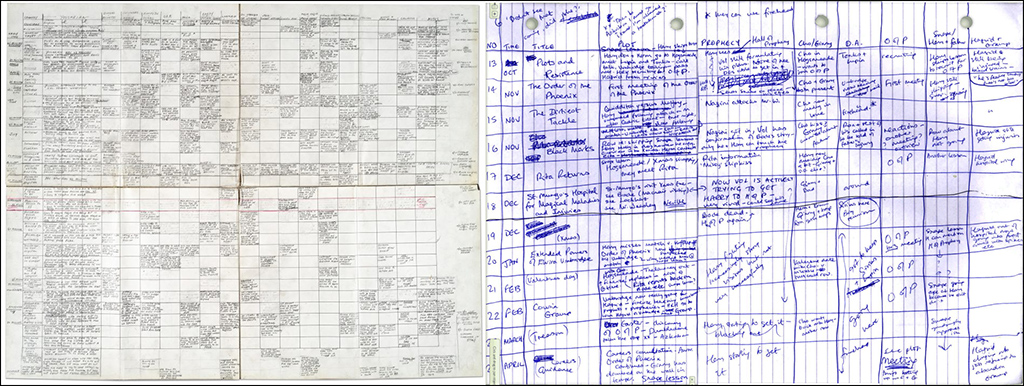
Side note: Authors like Joseph Heller (Catch-22) and J.K. Rowling (Harry Potter and the Order of the Phoenix) used plot grids to keep track of things. This is conceptually somewhere between Step 3 and Step 5 – I prefer to separate these two steps.
Examples of plot grids used by Heller and Rowling
Images from www.openculture.com
Immerse yourself in the story of each cast member, one at a time. Write it, set it aside, and come back to it later. Refine it. Soon, you will know not only what they want, but also what it means and feels like to want that thing. You will grok them, as the kids say.
With all your future histories laid out, it’s time to get out those numbers.
Step 4: Prepare the World Canon
A narrative is, minimally, a series of events. In the case of the Baudelaire orphans and Lemony Snicket, these events may be unfortunate.
Events happen at a particular moment, so your world canon will be a timeline, listing the date and an event on that date. This is where canon lives; it is the history of the world.
I find it easiest to use a spreadsheet to record this. Each row is an event, column 1 is when it happened, and column 2 is what happened.
Create a blank sheet, label it “World Canon”, and your official timeline is ready.
Step 5: Prepare the Rigorous Agent Timeline
In this step, you place the future history of each Support Cast member on a rigorous timeline.
Start by creating a blank sheet for a cast member. Then work through the future history of that cast member and identify events in the story. Verbs are the spotlight for events. Assign each event a reasonable date, based on what’s happened before and how long you think an event needs. Add this date and event pair to the spreadsheet.
Repeat the above for each cast member, creating separate timelines for each.